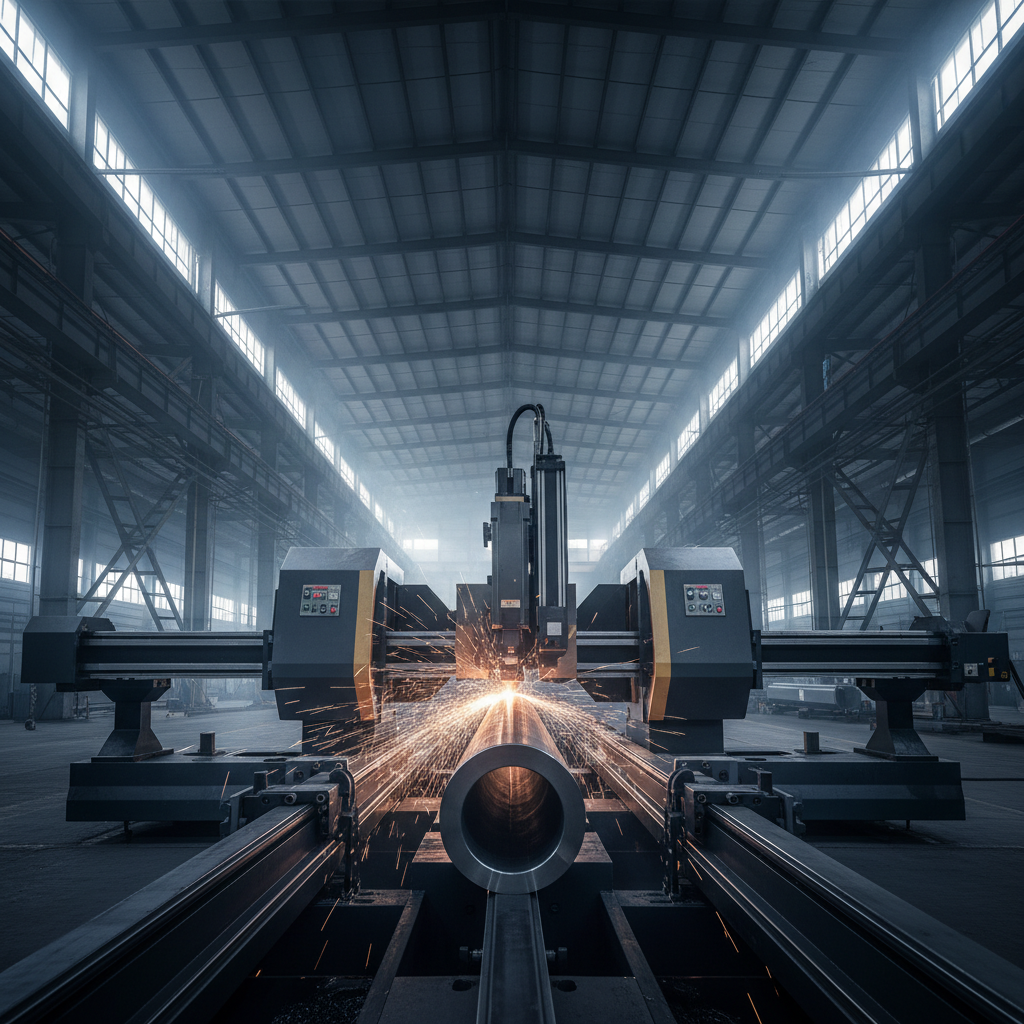
Selecting the right partner among global steel line pipe manufacturers requires more than just a price comparison; it demands a deep dive into the metallurgical integrity and the precision of the rolling equipment used. The quality of a welded pipe is fundamentally tied to the stability of the rolling molds and the consistency of the heat treatment process.
For industrial procurement officers, the challenge lies in distinguishing between standard production and high-precision engineering. The difference often manifests in the wear resistance of the pipe and the longevity of the production line, which are directly influenced by the forging ratio and the quenching stability of the machinery components.
This analysis explores the technical benchmarks of pipe manufacturing equipment, the critical role of professional roll mold processing, and how integrated automation is reshaping the efficiency of welded pipe production units.

Technical Foundations of Welded Pipe Production Equipment

Modern pipe production is an integrated sequence involving feeding sections, straightening machines, and high-frequency welding units. The core of the process resides in the metal forming stage, where the raw steel strip is gradually shaped into a cylindrical form. This requires extreme synchronization between the longitudinal shearing units and the cold cutting flying saws to maintain dimensional tolerance.
The efficiency of these systems depends heavily on the auxiliary machinery, such as automatic chamfering machines and balers, which ensure that the pipe ends are prepared for seamless integration into larger pipeline networks. A failure in any single section—be it the feeding or the straightening—can lead to eccentricity in the final product.
To optimize these lines, manufacturers focus on the synergy between the machining molds and the welding equipment. By integrating advanced automation, the labor intensity is reduced, and the output consistency is increased, which is vital for meeting strict ISO9001 quality management standards.
The Critical Impact of Roll Mold Precision on Pipe Quality
The longevity of a production line is determined by the roll mold's wear resistance. A professional roll mold process begins with a precise forging ratio (typically 3: 2-2.5) and repeated heating between 850°C and 1000°C. This ensures that the internal organization of the metal is refined, significantly enhancing the hardness and stability of the mold during high-pressure forming.
Following the rough processing of the inner hole and outer shape, the workpiece undergoes a critical quenching phase. Warming up to 930-980°C followed by controlled cooling allows the hardness to reach the optimal range of 58° to 62°. Without this specific thermal cycle, the molds would deform under the stress of continuous production, leading to inconsistent pipe wall thickness.
Final planar and inner hole finishing are the last steps to ensure that the mold conforms exactly to the technical drawings. This level of detail prevents micro-stresses in the steel line pipe, reducing the likelihood of weld failure or structural collapse during high-pressure applications.
Industrial Application Scenarios for Welded Pipe Units
Welded pipe equipment is deployed across various heavy industrial sectors, from oil and gas transportation to structural engineering. In these environments, the pipe must withstand corrosive agents and extreme pressure variations, making the quality of the weld and the roundness of the pipe critical.
In large-scale steel pipe companies, such as those utilizing comprehensive welded pipe units, the integration of feeding sections and automatic shearing is essential for high-volume throughput. These units allow for the production of various specifications of pipes that are used in everything from municipal water systems to industrial chemical conduits.
Furthermore, the use of specialized roller molds allows manufacturers to pivot quickly between different pipe diameters and wall thicknesses. This flexibility is crucial for suppliers serving diversified markets, enabling them to meet custom project requirements without extensive downtime for equipment reconfiguration.
Evaluating Manufacturing Efficiency through Technical Metrics
Efficiency in pipe manufacturing is not just about speed, but the ratio of usable output to raw material input. Technical metrics such as the forging ratio of molds and the stability of the quenching furnace directly correlate with the reduction of scrap rates and the increase in operational uptime.
When comparing standard equipment to high-precision units, the most notable differences appear in the wear rate of the consumables and the precision of the flying saw cuts. High-performance systems minimize material waste through optimized longitudinal shearing and precise automatic cutting.
steel line pipe manufacturers Performance Metrics
As shown in the data, precision-engineered components significantly improve the durability of the equipment, reducing the frequency of mold replacements and ensuring that the production line maintains a high standard of quality over longer operational cycles.
Strategic Procurement Considerations for Pipe Machinery
Procuring welded pipe equipment is a long-term investment that requires a rigorous evaluation of the supplier's technical capabilities. Buyers should prioritize manufacturers who can provide a full range of services, from the initial design of the production unit to the supply of high-precision roller molds and auxiliary machinery.
Critical evaluation factors include the supplier's heat treatment capabilities and their ability to maintain strict hardness tolerances (e.g., 58°-62° HRC). A manufacturer with an in-house forging and heat treatment workshop is generally more reliable than one that outsources these critical processes.
Furthermore, the ability to integrate automation—such as automatic shearing and feeding sections—is a key differentiator. Automation not only solves staffing challenges but also reduces the risk of human error in the forming and cutting phases, leading to a more predictable ROI.
Automation Trends in Metal Forming and Cutting Technology
The industry is moving toward fully autonomous production cells where the interaction between the straightening machine and the welding unit is controlled by real-time feedback loops. This trend is likely to further reduce the labor intensity and improve the precision of the pipe's wall thickness.
New developments in cold cutting flying saws and longitudinal shearing units are enabling faster cycle times without compromising the edge quality of the steel strip. These innovations are essential for manufacturers dealing with higher-strength alloys that require more force and precision to form.
Integration of AI-driven quality inspection, combined with professional quality inspectors at each process step, could lead to a zero-defect manufacturing environment. This evolution depends on the continued refinement of roll mold materials and the adoption of smarter heat treatment protocols.
Comparing Technical Approaches in Pipe Manufacturing Solutions
Depending on the production volume and the required pipe specifications, manufacturers may choose between different equipment configurations. The choice between a basic welded pipe unit and a fully automated system depends on the target market and the available technical staffing.
The following table compares different technical approaches used by professional equipment providers to optimize the production of steel line pipes.
| Technical Approach | Primary Focus | Operational Impact | Best Use Case |
|---|---|---|---|
| High-Ratio Forging | Mold Internal Structure | Increased Wear Resistance | Heavy-duty Industrial Pipes |
| Precision Quenching | Hardness Stability | Reduced Dimensional Drift | High-Precision Thin Wall Pipes |
| Integrated Automation | Labor Reduction | Higher Throughput Rate | Mass Production Facilities |
| Custom Roller Molds | Geometric Flexibility | Rapid Product Switching | Diverse Spec Order Processing |
| Cold Cutting Saws | Edge Precision | Reduced Finishing Waste | High-Grade Alloy Steel Pipes |
| Full-Service Integration | System Synergy | Lower Setup Complexity | Greenfield Factory Projects |
Ultimately, the most effective solution is one that balances the hardness of the tooling with the automation of the process. Those seeking comprehensive systems can review the relevant product and company information available through www.xhequipment.com.
Frequently Asked Questions
Conclusion
The pursuit of excellence in steel line pipe production is an exercise in precision engineering. From the rigorous thermal cycles of roll mold production to the seamless integration of automated feeding and cutting systems, every detail contributes to the final product's integrity. For manufacturers, investing in equipment that prioritizes metallurgical stability and process automation is the only sustainable path to maintaining a competitive edge in a demanding global market.
By focusing on high-precision components and integrated solutions, companies can achieve a balance of high throughput and uncompromising quality. Those evaluating their current production capabilities or planning new installations can find detailed technical specifications and solution guides at www.xhequipment.com.