Pipe laser cutting is rapidly transforming modern manufacturing and fabrication processes across a diverse range of industries. This innovative technology utilizes a focused laser beam to precisely cut through metallic pipes of varying thicknesses and materials, offering unparalleled accuracy, speed, and efficiency compared to traditional methods. The demand for intricate pipework in sectors like oil and gas, construction, and automotive is consistently growing, making pipe laser cutting a critical skill and investment for businesses seeking to remain competitive in today's global market.
Globally, the pipe laser cutting market is experiencing substantial growth, driven by increasing infrastructure development, stringent quality requirements, and the need for cost-effective manufacturing solutions. According to a report by Grand View Research, the global laser cutting machine market was valued at USD 4.21 billion in 2022 and is projected to reach USD 7.76 billion by 2030, with pipe cutting being a significant segment. This expansion is particularly pronounced in emerging economies like China and India, where large-scale infrastructure projects are fueling demand for precise and efficient pipe fabrication.
The increasing adoption of pipe laser cutting isn’t merely about technological advancement; it represents a fundamental shift towards more sustainable and agile manufacturing practices. By minimizing material waste, reducing energy consumption, and enabling complex designs, this technology contributes to a more responsible and efficient industrial ecosystem. Understanding the nuances of pipe laser cutting is essential for engineers, manufacturers, and anyone involved in the design and construction of modern infrastructure.
Introduction to Pipe Laser Cutting
Pipe laser cutting stands as a cornerstone of modern metal fabrication, enabling the creation of complex geometries with unmatched precision. Unlike traditional cutting methods, pipe laser cutting offers a non-contact approach, minimizing material distortion and maximizing the integrity of the finished product. This capability is particularly crucial in industries where structural stability and dimensional accuracy are paramount.
The process involves directing a high-powered laser beam onto the pipe’s surface, vaporizing the material along the desired cutting path. Advanced software and motion control systems ensure that the laser follows intricate designs with remarkable accuracy. The resulting cuts are clean, burr-free, and require minimal post-processing, saving time and resources.
The Global Relevance of Pipe Laser Cutting
Pipe laser cutting is globally relevant due to the widespread use of pipes across numerous industries. From oil and gas pipelines transporting vital resources to the intricate plumbing systems in residential buildings, pipes form the backbone of modern infrastructure. The demand for high-quality, precisely cut pipes is therefore consistently high across the globe, and the ability to meet these demands efficiently and accurately is paramount for economic growth and development.
Emerging economies are witnessing a significant surge in infrastructure projects, further amplifying the need for advanced pipe fabrication technologies. Countries in Southeast Asia, Africa, and Latin America are investing heavily in upgrading their infrastructure, creating a substantial market for pipe laser cutting solutions. The United Nations Sustainable Development Goals (SDGs), particularly Goal 9 (Industry, Innovation, and Infrastructure), underscore the importance of investing in robust and sustainable infrastructure, driving the adoption of technologies like pipe laser cutting.
The pursuit of more efficient and sustainable manufacturing practices is also a global trend driving the demand for pipe laser cutting. Traditional pipe cutting methods often generate significant material waste and require extensive post-processing, which can be both costly and environmentally damaging. Pipe laser cutting minimizes waste, reduces energy consumption, and enables the creation of lighter, stronger structures, contributing to a more sustainable industrial ecosystem.
Defining Pipe Laser Cutting
Pipe laser cutting is a subtractive manufacturing process that uses a focused, high-powered laser beam to cut through metallic pipes. It differs from traditional methods like sawing, plasma cutting, and waterjet cutting by offering superior precision, speed, and quality. The laser beam melts, burns, or vaporizes the material, leaving a clean, smooth edge with minimal heat-affected zone.
This technology is intricately connected to modern industry by allowing for the creation of complex pipe geometries for applications requiring high precision and repeatability. From shipbuilding and aerospace to the automotive and energy sectors, pipe laser cutting enables the production of vital components that meet stringent quality standards. It allows for the efficient fabrication of everything from small diameter tubing to large diameter structural pipes.
Beyond industrial applications, pipe laser cutting also contributes to humanitarian needs. In disaster relief efforts, the rapid fabrication of customized pipe structures for temporary shelters, water purification systems, and medical facilities can be life-saving. Its adaptability and precision make it a valuable tool in responding to emergency situations and rebuilding communities.
Key Factors in Pipe Laser Cutting Technology
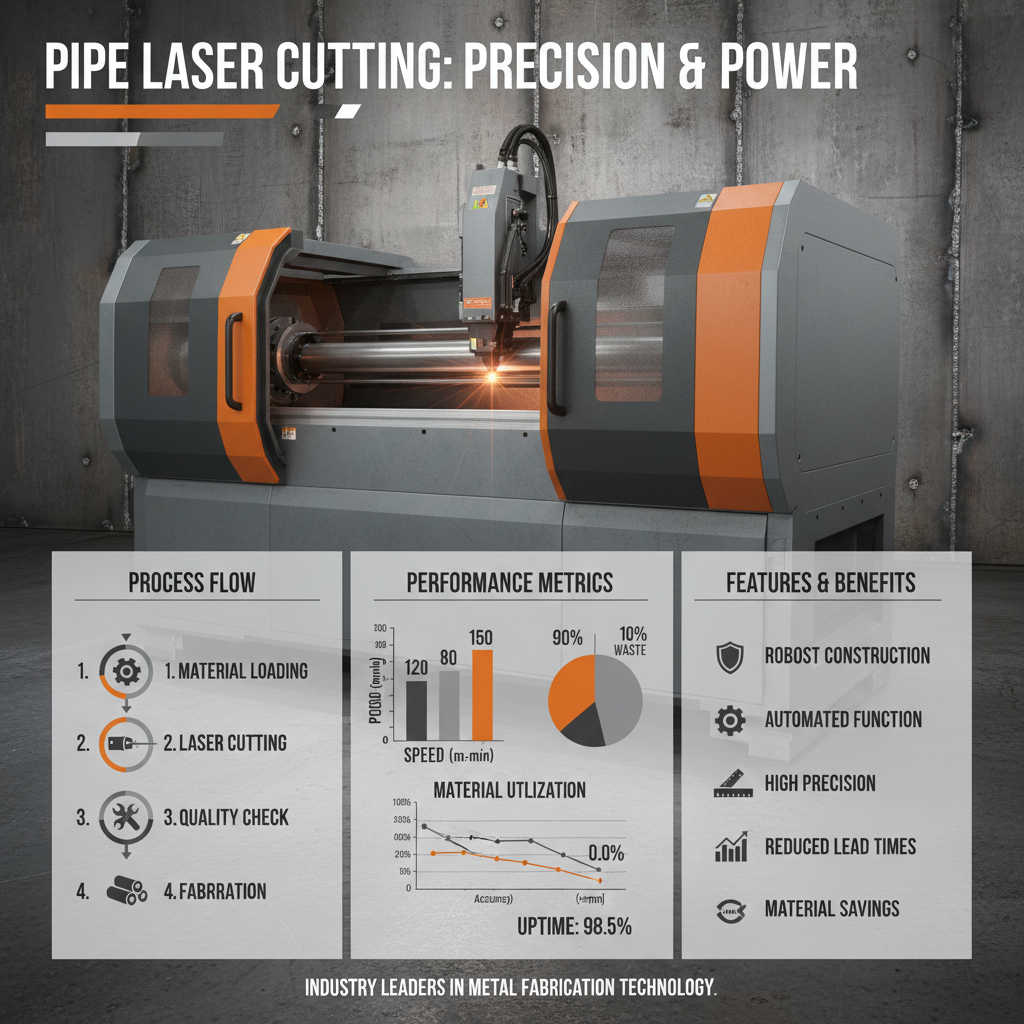
One crucial factor is Precision. Pipe laser cutting delivers unparalleled accuracy, ensuring that cuts are made exactly to specification. This is especially important in industries where tolerances are tight and structural integrity is critical. Another key aspect is Speed. Laser cutting significantly reduces fabrication time compared to conventional methods, boosting productivity and reducing costs.
Versatility is also paramount. Pipe laser cutting can handle a wide range of materials, including carbon steel, stainless steel, aluminum, and alloys, making it suitable for diverse applications. Finally, Automation plays a vital role. Modern pipe laser cutting machines are often integrated with automated loading and unloading systems, minimizing manual intervention and maximizing efficiency.
Pipe Laser Cutting Performance Metrics
Global Applications and Use Cases
Pipe laser cutting finds extensive application in the oil and gas industry, where it's used to fabricate pipelines, fittings, and other critical components. Its precision ensures leak-proof connections and structural integrity, vital for safe and reliable transportation of oil and gas. In the construction sector, pipe laser cutting is employed for creating structural supports, handrails, and customized pipework for buildings and infrastructure projects.
The automotive industry also leverages pipe laser cutting for manufacturing exhaust systems, chassis components, and safety cages. Its ability to create complex shapes and precise cuts contributes to lighter, stronger, and more fuel-efficient vehicles. In remote industrial zones, where access to skilled labor may be limited, automated pipe laser cutting systems provide a reliable and efficient solution for fabricating essential components on-site.
Advantages and Long-Term Value
The advantages of pipe laser cutting are numerous, starting with significant cost savings. Reduced material waste, decreased labor costs, and minimized post-processing all contribute to a lower overall production cost. Furthermore, the increased precision and quality of laser-cut pipes lead to fewer defects and improved product reliability, reducing the risk of costly repairs and replacements.
Beyond the economic benefits, pipe laser cutting offers long-term value in terms of sustainability. By minimizing material waste and reducing energy consumption, it aligns with environmentally responsible manufacturing practices. The enhanced safety resulting from clean, burr-free cuts contributes to a safer working environment for employees. This innovation fosters trust with clients who value quality, efficiency, and a commitment to sustainability.
Future Trends and Innovations
Future trends in pipe laser cutting point towards increased automation, integration with Industry 4.0 technologies, and the development of more powerful and efficient laser sources. The adoption of artificial intelligence (AI) and machine learning (ML) will optimize cutting parameters, predict potential issues, and further enhance the precision and efficiency of the process. The integration of digital twins will allow for virtual prototyping and simulation, reducing lead times and minimizing costly errors.
The exploration of new materials, such as advanced alloys and composites, is also driving innovation in pipe laser cutting. The development of specialized laser sources tailored to these materials will expand the range of applications for this technology. Furthermore, a growing emphasis on green energy and sustainable manufacturing will accelerate the adoption of pipe laser cutting as a means of reducing environmental impact.
We can also expect to see advances in beam shaping and control, allowing for even more intricate and complex pipe geometries to be cut with greater precision. Cloud-based software solutions will enable remote monitoring, diagnostics, and optimization of pipe laser cutting operations, fostering collaboration and improving overall efficiency.
FAQS
Pipe laser cutting is incredibly versatile and can effectively process a wide range of materials. Commonly cut materials include carbon steel, stainless steel, aluminum, and various alloys. The specific laser parameters need to be adjusted based on the material’s properties, such as reflectivity and thermal conductivity, to ensure optimal cutting performance and quality. Specialized laser sources can even handle materials like titanium and copper, though these often require more advanced systems.
Cutting speed is heavily dependent on the pipe's material, thickness, and the laser's power. For example, a 1kW laser might cut 6mm mild steel at around 8 meters per minute, while a 4kW laser could achieve 15 meters per minute. Thicker materials naturally require slower speeds to ensure a clean and accurate cut. Stainless steel generally requires slower speeds than carbon steel due to its higher reflectivity. Precise cutting speeds are often determined through testing and optimization.
Pipe laser cutting boasts exceptional precision, typically achieving tolerances of ±0.1mm to ±0.2mm. This level of accuracy is crucial for applications requiring tight dimensional control and complex geometries. Advanced laser systems with high-resolution motion control and feedback mechanisms further enhance precision. The ability to cut intricate designs with minimal heat-affected zone contributes to the overall quality and dimensional stability of the finished product.
While plasma cutting is generally less expensive upfront, pipe laser cutting often proves more cost-effective in the long run due to its higher precision, reduced material waste, and lower post-processing requirements. Laser cutting produces cleaner, more accurate cuts with minimal burr formation, eliminating the need for extensive deburring or grinding. The improved quality and reduced rework translate to lower overall manufacturing costs. Additionally, laser cutting offers greater versatility and can handle a wider range of materials.
Regular maintenance is crucial for ensuring optimal performance and longevity of a pipe laser cutting machine. Key maintenance tasks include cleaning the optics (lens and mirrors) to maintain laser beam quality, checking and replacing consumable parts (nozzles, ceramic rings), lubricating moving parts, and inspecting the beam path alignment. Preventive maintenance schedules should be followed diligently, and trained technicians should perform more complex repairs and adjustments.
Safety is paramount when operating a pipe laser cutting machine. Operators should always wear appropriate personal protective equipment (PPE), including laser safety glasses, gloves, and protective clothing. The machine enclosure should be properly interlocked to prevent accidental exposure to the laser beam. Proper ventilation is essential to remove fumes and particles generated during the cutting process. Regular safety training and adherence to established safety protocols are critical.
Conclusion
In conclusion, pipe laser cutting represents a transformative technology that is reshaping the landscape of metal fabrication. Its precision, speed, versatility, and cost-effectiveness make it an indispensable tool for a wide range of industries. From enhancing infrastructure development and improving manufacturing efficiency to promoting sustainability and enabling innovative designs, pipe laser cutting offers compelling advantages across the board.
As technology continues to evolve, we can expect even more advancements in pipe laser cutting, driven by the integration of AI, automation, and new materials. Investing in this technology is not merely a strategic business decision, but a commitment to innovation, sustainability, and long-term success. Visit our website at www.xhequipment.com to learn more about how we can help you leverage the power of pipe laser cutting.